Cabo ATV and Camel Tours: Fun, but Not on a Short Trip
By Cabo Wander
Cabo ATV and camel tours usually get booked because one person in the group has seen a picture of a quad on a beach and wants to go. These tours are well run, the guides are good, and most people come back happy. What you get is about an hour of dusty follow-the-leader behind a guide. If somebody in your group has their heart set on it, go and have fun. If nobody does, I wouldn't give it a morning of a short trip.
And if you do go, take the side-by-side, the one with a roll cage and seat belts, over the sit-on quad. Expect to pay well over the price you clicked on, too. The listed price is a bit over half of what two people hand over, and that's before anybody buys a photo.
It took me a while to see that the riding is the easy part, and it's short. Nearly everything I didn't love happened at the check-in desk, where the entrance fee, the damage waiver and the phone locker all show up, and where the photo package is waiting when you get back.
I left both the ATVs and the camels out of my top ten things to do in Cabo, and this is the longer explanation.
What These Tours Actually Are
It's a guided convoy on a set track, and I want you to have that picture in your head before you book. A lot of people arrive imagining open dunes and going wherever they like.
Most of the tours run at Migriño, a Pacific beach and a wide dry riverbed about 25 minutes up the highway from Cabo San Lucas. Cabo Adventures runs its tours on its own ranch about 45 minutes north of town. Wild Canyon is a different kind of day, a canyon park with ziplines and UTVs where you move from one activity to the next with a wristband, and teenagers love it.
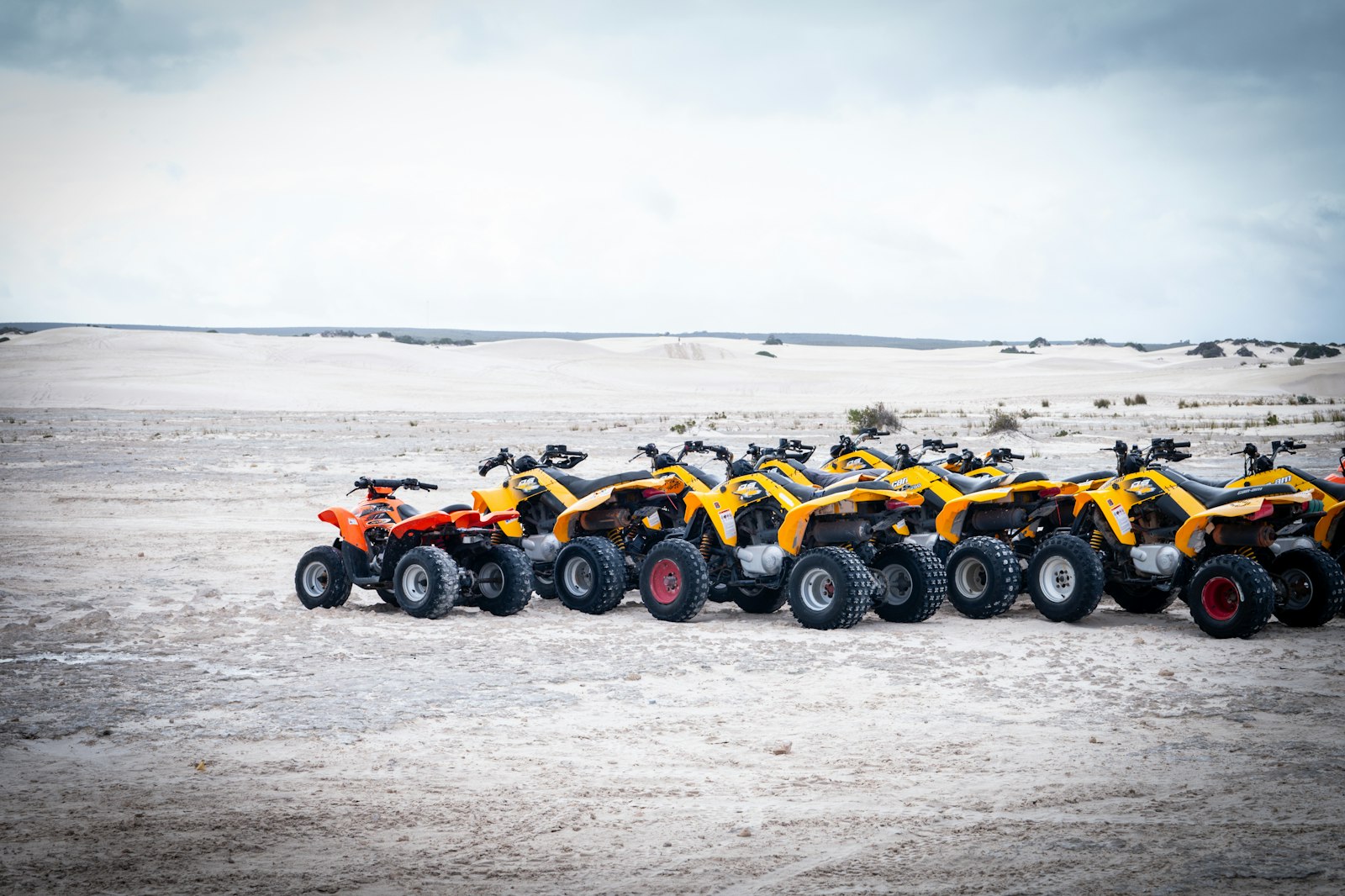
The morning goes like this. A van picks you up, then picks up everybody else. At the base you pay the fees I'll get to below, your phone goes in a locker, and you're handed a helmet, goggles and a bandana for your nose and mouth. There's a safety talk and a practice loop, and both are done properly. Then you ride single file behind the guide, through sand and tall cactus and out along the top of the beach, while a photographer on his own quad gets ahead of the group and waves you through a posed stop.
I liked that beach, which is big and loud and really is a view, and in winter you might see a whale blow while you're stopped there. The guides are patient with nervous riders and funny with everyone else.
What I'd want you to know is that everybody except the leader rides in somebody else's dust, and I mean a LOT of dust. The track is easy. If you've ridden off-road before, you'll be bored. And the driving is about an hour inside an outing of four or five hours door to door. I've had it come in under the hour, too.
You finish with a tequila tasting, which is also a shop, and then the photo desk. I had sand in my ears until the shower.
Which One, If You're Going
Take the side-by-side. It's also called a UTV or a RZR, and it has a cage, belts and seats for two or four, so your group rides together and shouts at each other the whole way. The driver has most of the fun, so trade seats if they'll let you. With three or four of you in one vehicle it also works out cheaper per head than putting everyone on quads.
The single sit-on quad is the most fun for a confident rider, I'll admit that. It's also the one I'd talk you out of, and the safety section says why. The double, with a passenger on the back, is the cheapest way in, and the person on the back is the least protected person on the whole tour. I wouldn't put a child or a nervous friend there.
The camel ride is about twenty minutes on a rope lead, and it has its own section further down.
The combos put a camel walk on the end of an ATV or UTV ride. They're fine if you want both, as long as you know that each half is short. There's also one that pairs the camels with a quick visit to a town up the coast, and I'd do the town properly by car, the way I lay out in my Todos Santos day trip.
If what you really want is an animal and a beach without an engine, Cuadra San Francisco on the Corridor is a proper riding stable, and I'd call them before I'd book a horse as an add-on at an ATV base.
What It Really Costs
Budget one and a half to two times the price on the listing.
Three things get added at the desk on pretty much every tour:
- An entrance fee of about US$20 to $25 a person. It's sometimes called a park fee or a land conservation fee, and I've never been told what it conserves.
- The damage waiver of about US$25 to $50 a vehicle. That one is per vehicle, so sharing helps.
- A tip of 10 to 15% of the ticket, in cash. My whole tipping table is in how much Cabo costs.
For two people it works out like this. These are my own rough sums, rounded, so use them for the shape and don't hold me to the dollar.
- The cheapest ATV tour, two of you on one quad. Listed at around US$55 a head. It lands around US$110 a head, so about US$220 for the pair.
- A camel and ATV combo with lunch, a quad each. Listed at around US$120 a head. It lands around US$190 to $200.
- A side-by-side with lunch, two of you sharing. Listed at around US$140 a head. It lands around US$200.
Look at what happened there. The cheapest listing doubled, and the one that looked the most expensive had the least added to it. The cheap one also leaves out lunch, and at some places an automatic quad is an upgrade. So I compare totals, and I check whether a price is per person or per vehicle, because listings mix those up constantly.
Then there are the photos. On a shared tour, phones generally aren't allowed on the vehicles. The reason given is safety, and it's a fair one, since someone filming with one hand is a danger to everyone behind them. It also means the operator's photographer is the only camera out there. Pictures run from about US$20 for a single print to well over US$100 for the album, and some operators charge a fee to carry your own phone. So ask the price before you smile.
If the price was quoted in dollars, ask for your card to be charged in dollars. A desk may run it in pesos at its own rate.
It's the same pattern as a fishing charter here, where the quote is only the start, and I walk through that one in sport fishing in Cabo.
The "Insurance" at the Desk
Decide what you're doing about this before you're standing at the counter, because the counter is a bad place to think.
It gets called insurance, collision cover or a protection benefit, and what it is depends on who you booked with. At some operators it's mandatory. Cabo Adventures calls it that in writing and prints the price, which I appreciate. At others it's "optional", and if you say no, a hold of several hundred dollars goes on your credit card and can sit there for a week or more. It's set up so that almost everyone buys it, and the pitch can get heavy.
I'd just pay it and count it as part of the ticket.
What I want you to be clear on is what you bought. Where the wording is public, the fee exempts you from damage charges to the vehicle. I haven't found anything, anywhere, that says it pays your medical bills.
And I can't tell you much more than that, because I've never seen the full written terms. I don't know if there's a deductible, or whether it still applies if you left the track. So ask before you sign: what would I owe if I roll this, with the waiver and without it? Get the answer in writing if you can.
Take a picture of your vehicle, all four sides, before your phone goes in the locker.
Safety, Plainly
Most people come back dusty and nothing worse. People do get badly hurt on these machines, though.
The injuries are rollovers, riders running into each other, and falls, and the usual result is a broken bone. Nobody publishes numbers, so I can't tell you how often it happens. I don't know of anyone being killed on one of these tours here, and I'm not suggesting it.
The vehicle is the biggest choice you get to make. A side-by-side has a roll cage and seat belts. On a quad you sit on top of the machine with a helmet and nothing else, and a passenger on the back has a helmet and the driver's waist to hold. The plainest local safety advice I've come across says not to rent the sit-on kind at all, and I agree with it.
A few rules I'd keep:
- Don't drink before you ride. The tequila tasting is scheduled for afterward, and that's where it belongs. Book the first tour of the day, before anyone in your group has been at the pool bar.
- Leave the gap. The convoy bunches up behind the guide. Ride at the speed you're comfortable with and let the space open in front of you.
- Take the exclusions seriously. If you're pregnant, or you have a back, neck or heart problem, these tours are not for you, and every operator says so in its terms.
- Check the driving age. It's 16 or 18 depending on the operator, with a driver's license in hand. Passengers start at somewhere between five and eight, and kids get a height check for the side-by-side.
Then there's what happens if it goes wrong. You're half an hour or more from a private hospital, and it will want a card up front. Nothing you paid for at the tour desk helps with that. Your own travel medical policy is the only cover you have, and many policies exclude ATVs and off-road vehicles as a hazardous activity. Read yours for those words before you leave home, and ask the insurer in writing if it isn't clear. How the hospitals here work is in is Cabo safe.
If your policy doesn't cover it, I'd skip the tour.
The Camels
The camel ride is about twenty minutes. A handler leads the animal on a rope along the sand and back, you get on from a platform, and a photographer takes your picture. The rest of a camel tour is a walk, lunch and a tasting. At some places the ride itself is shorter than that.
Camels aren't native to Baja. They're here because of the tours.
Here is what's known about how they're kept, and it isn't much. The best-known operator, Cabo Adventures, says its animals came from a sanctuary and from working lives they've since been retired from. It publishes rest days, access to a vet and a rider weight limit of about 265 pounds that it checks on a scale. Its camel operation holds a humane certification. The organization that issued it is an established one, and some animal-welfare groups dispute how much its certificates are worth. All of the rest is the operator's own account.
Nobody independent has assessed the welfare of these animals, in either direction. I haven't found anything that shows they're mistreated, and I haven't found anything that shows they aren't. About the camels at the other operators, nothing is documented at all.
I skip it. That's a personal call, the same one I make about a few other animal attractions here, and you'll make your own. If you go, I'd choose the operator that puts its standards in writing. Judged only as an activity, it's a photo and a good lunch, and it's the weakest value on the menu.
How to Book It and What to Ask
Book directly with an operator that prints its fees on its own website. Cabo Adventures is the most open about it. The entrance fee, the waiver, the age and weight limits and the phone rule are all on the page, and its desert tours include the ride from your hotel, lunch and a beer. It's rarely the cheapest listing, and its total holds the fewest surprises.
A reseller's low price doesn't make the fees go away. They're paid at the park whoever sold you the ticket. A hotel desk sells the same van with a commission on top.
The one I'd walk past is the "discount" or free ATV tour from a booth. You'll be offered it in the rooms after customs, which I map out in my Cabo airport guide, and again by the sellers on the marina, who I cover in my Cabo San Lucas guide. The price is a sales pitch that takes most of a morning, plus a deposit, and the entrance fee and waiver are still waiting for you at the park. The whole trade is in my post on the Cabo timeshare presentation.
Here's what I ask before I pay:
- What's the total per person at check-in, with the entrance fee and the insurance?
- Is the insurance mandatory? If I say no, how big is the hold?
- Is this price per person or per vehicle, and is the quad automatic?
- How many minutes of actual driving, and how many vehicles in the group?
- Can I carry my phone? If I can't, what do the photos cost?
- How old do you have to be to drive, and do you need to see a license?
- Is lunch included? Is the ride from my hotel?
On a tour that goes down to the beach, I'd also ask whether the route stays off the sand during turtle nesting season.
You don't need to plan far ahead. A day or two is enough outside the Christmas and Easter weeks, and the pickup needs about a day's notice anyway. Pay for the tour by card and bring small bills for the tip.
When to Go
Go between November and April, on the first tour of the day. That's usually 8 or 9am. It's cooler, the light is better, and nobody has started drinking yet.
From July to September it's in the mid 90s and humid by late morning, and you're in a helmet and long sleeves with no shade. I'd skip it then, or take the earliest slot and nothing later. Late summer is also when the year's rain arrives in a few big storms, and those can turn a dry riverbed into a running one.
Spring is the dustiest stretch, dry and windy on the Pacific side. Wear clothes you don't care about, and if you wear contact lenses, bring your glasses. The month-by-month picture is in the best time to visit Cabo.
Who'll Love It and Who Should Skip It
Here's who I'd send:
- A group of friends, or a bachelor or bachelorette party. A four-seat side-by-side, in the morning, before the pool.
- Families with teenagers. Check the driving age before you promise anyone the wheel.
- Families with kids from about five to ten. As passengers in a side-by-side, after the height check. I wouldn't put them on the back of a quad.
- Cruise passengers. It fits the clock, and it'll be your whole day in port.
And who I'd send somewhere else:
- Couples on a first trip of four or five days. Spend the morning on the water. In winter that's a small boat out to the humpbacks, and I compare the boats in whale watching in Cabo. In any month it's a free swim at Chileno Bay before the crowds.
- Anyone staying in San José. With pickups it's more than an hour each way, so you're giving five or six hours to one hour of driving.
- Experienced riders. It's an easy track at the guide's pace.
- Anyone who wants their own pictures. Your phone is in a locker.
- Anyone pregnant, or with a back, neck or heart problem. You'll be turned away at the desk, so don't find out there.
- Anyone whose travel medical policy excludes it.
If it's the desert you're after more than the engine, the guided hike up Mt Solmar is free and gets you cactus and both seas in under two hours.
The Verdict
The desert tours are a fun, well-organized, very dusty hour, and nobody needs one. I've left them out of my 5-day Cabo itinerary on purpose, because on a short trip that morning does more for you in the water.
What I liked is the beach at Migriño, the guides, and how much a group of friends laughs in a side-by-side. What I wish were different is the desk. I'd be a lot warmer about these tours if the price on the listing were the price, and if I could carry my own phone.
I'd do it again if a friend really wanted to, and I'd have a good time. I wouldn't book it for myself... and I'd still pass on the camels.
The short version: desert tour only if somebody's dying to go. Side-by-side, skip the sit-on quad. Book direct with a company that prints its fees, first slot of the day, November to April. Budget one and a half to two times the listed price for the entrance fee, the waiver and the tip. The waiver covers the vehicle and that's it, so check your travel medical policy covers ATVs before you fly. Photo of the vehicle before your phone goes in the locker. Ask the photo price before you smile. No drinks until the tequila at the end.
Quick Answers
Are ATV tours in Cabo worth it? For a group that really wants to drive something in the desert, yes, as a half day. On a short trip with nobody asking for it, I'd spend the morning on the water. You get about an hour of driving in a four to five hour outing.
How much does a Cabo ATV tour really cost? About one and a half to two times the listed price. An entrance fee of about US$20 to $25 a person, a damage waiver of about US$25 to $50 a vehicle and a tip get added, so the cheapest listing at around US$55 a head lands around US$110, before photos.
Should I book an ATV or a UTV? The UTV, also called a side-by-side. It has a roll cage and seat belts, and a sit-on quad has neither. With three or four people in it, it's also cheaper per head.
Do I need the insurance at check-in? At some operators it's mandatory. At others you can decline and take a hold of several hundred dollars on your card. It covers damage to the vehicle, and I haven't found anything that says it covers your medical bills.
How long is the camel ride? About twenty minutes, led by a handler on a rope. The rest of the tour is a walk, lunch and a tasting.