Scuba Diving in Cabo: I'd Give It One Morning
By Cabo Wander
Friends who dive always ask me the same two things before a Cabo trip. Is the diving any good, and should I bring my gear?
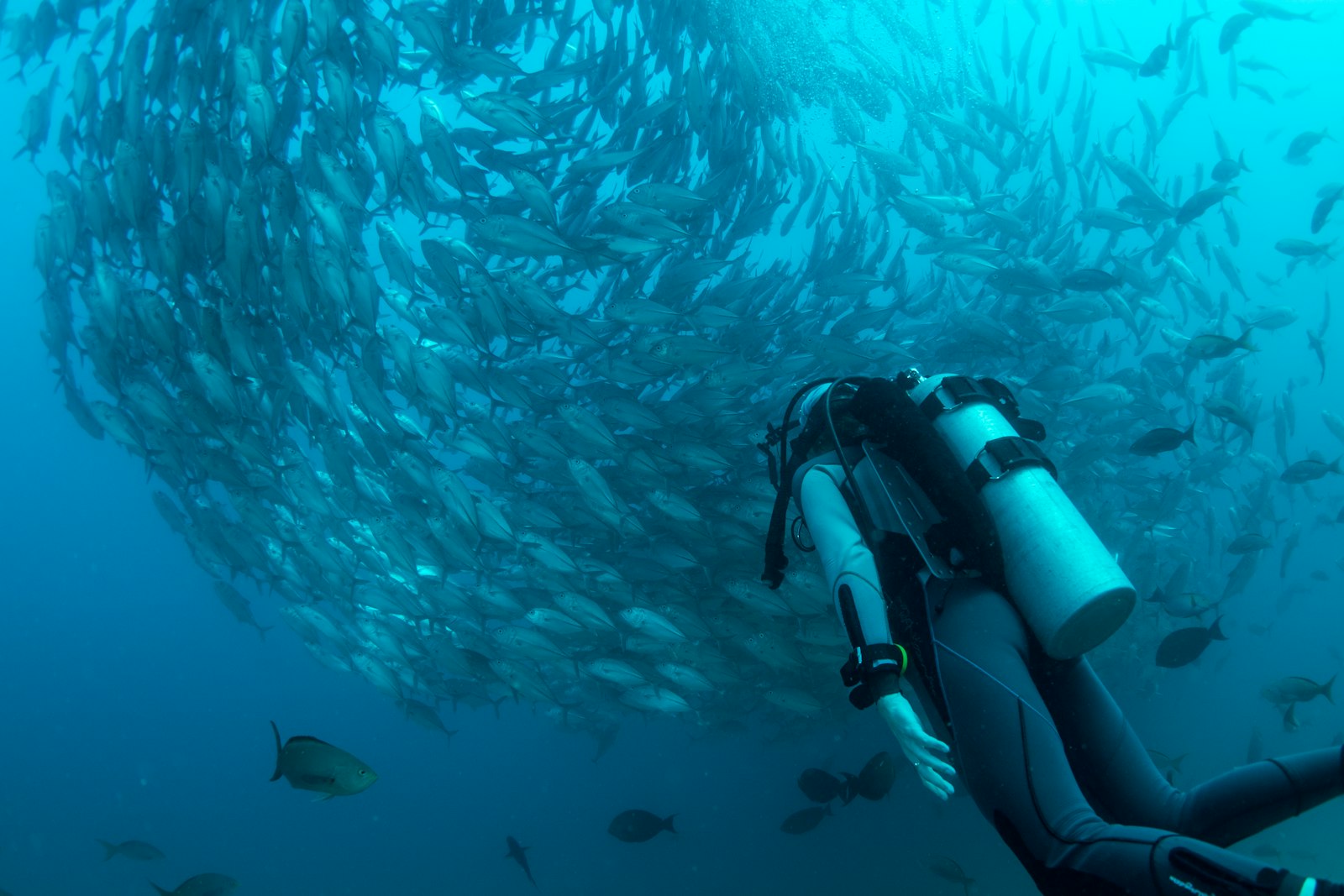
My answer is that Cabo is a really good place to spend one morning underwater, and I wouldn't plan a dive vacation around it. The reason to do it is how easy it is. You can finish breakfast, walk to the marina, and be on a wall dive with sea lions about five minutes after the boat leaves the dock. I don't know anywhere else in Mexico that makes it that simple. The fish are thick, the wall drops into a canyon, and you're back at the pool by lunch.
The same convenience is the catch. That wall sits under the busiest boat lane in town, the visibility is modest even in a good month, and for about half the year the water is cold and green.
So here's what I'd do. If you're certified, book one two-tank dive in the bay or along the Corridor, on the first boat of the morning, and come between August and December if you get to choose. If diving is a big part of why you travel, add a night at Cabo Pulmo. If you've never dived at all, read the section on first-timers before you spend the money, because for a lot of the year I'd hand you a mask and send you to the beach.
My ranked list of things to do in Cabo is written for everybody. This post is for the people who already own a dive computer, and the ones wondering if this is the trip to try it.
Four Different Days Get Sold as "Diving in Cabo"
This is the first thing to get straight, because the listings all look alike and the days are nothing alike. Each step down this list costs more, takes longer, and is less sure to deliver.
- The bay and Land's End: about four hours, five to ten minutes from the marina, around US$130 to $150 for two tanks.
- The Corridor: about five hours, a 30 to 40 minute boat ride each way, around US$150.
- Gordo Banks: six to eight hours, deep open water, for advanced divers, US$240 to $385.
- Cabo Pulmo: close to twelve hours from Cabo San Lucas for about US$325, or two short drives and a night in the village.
Those prices are for tanks, weights and a guide. Rental gear and the tip are on top, and I add all of that up further down.
Bottom line: the first two are a nice morning almost anyone certified can book. The last two are projects.
The Bay and Land's End
This is the dive most people should book, and it's the one I'd do first on any trip.
How the Morning Goes
You check in at a shop on the marina at 7:30 or 8. You show your certification card, sign a waiver, and get fitted for whatever gear you're renting. If it's been a year or more since your last dive, say so right here. Shops will run a refresher in the shallows or on the first dive, usually free or cheap, and it's a much better plan than finding out on a wall that you're rusty.
Then you walk your gear down the dock. Some shops' boats leave from a dock that charges a few dollars a head in cash, so have small bills. The ride out is five to ten minutes at idle speed past the fishing boats. The briefing takes longer than the commute.
The first dive is the deeper one, on the wall. You back-roll in, and on one side of you there's rock covered in sea fans and on the other side there's nothing but blue going down several hundred feet. In the fall the surface is in the mid 80s and it drops to the mid 70s somewhere around 70 or 80 feet. You can put your hand through the line where it changes. In March the surface is 71°F and it only gets colder from there.
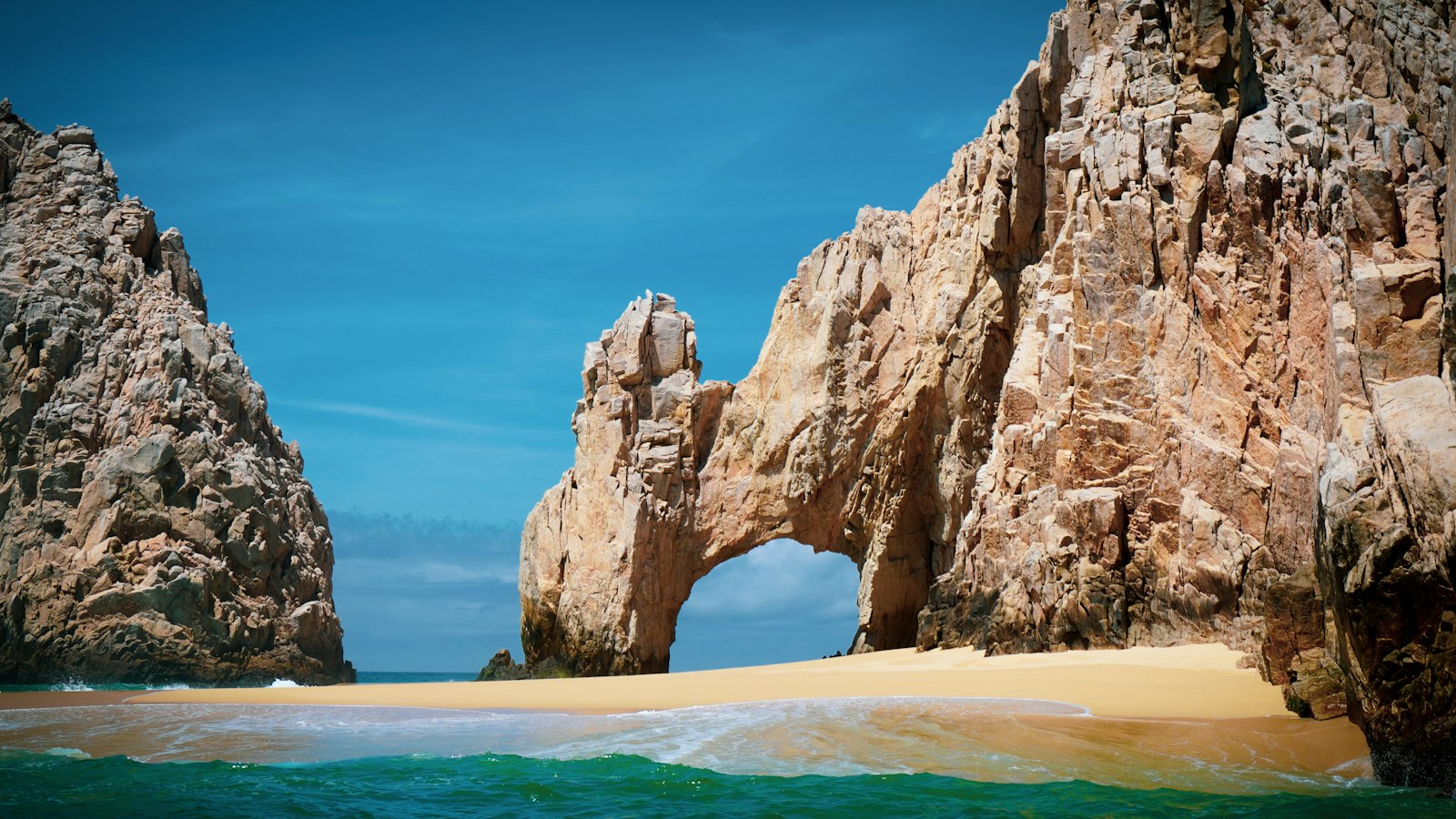
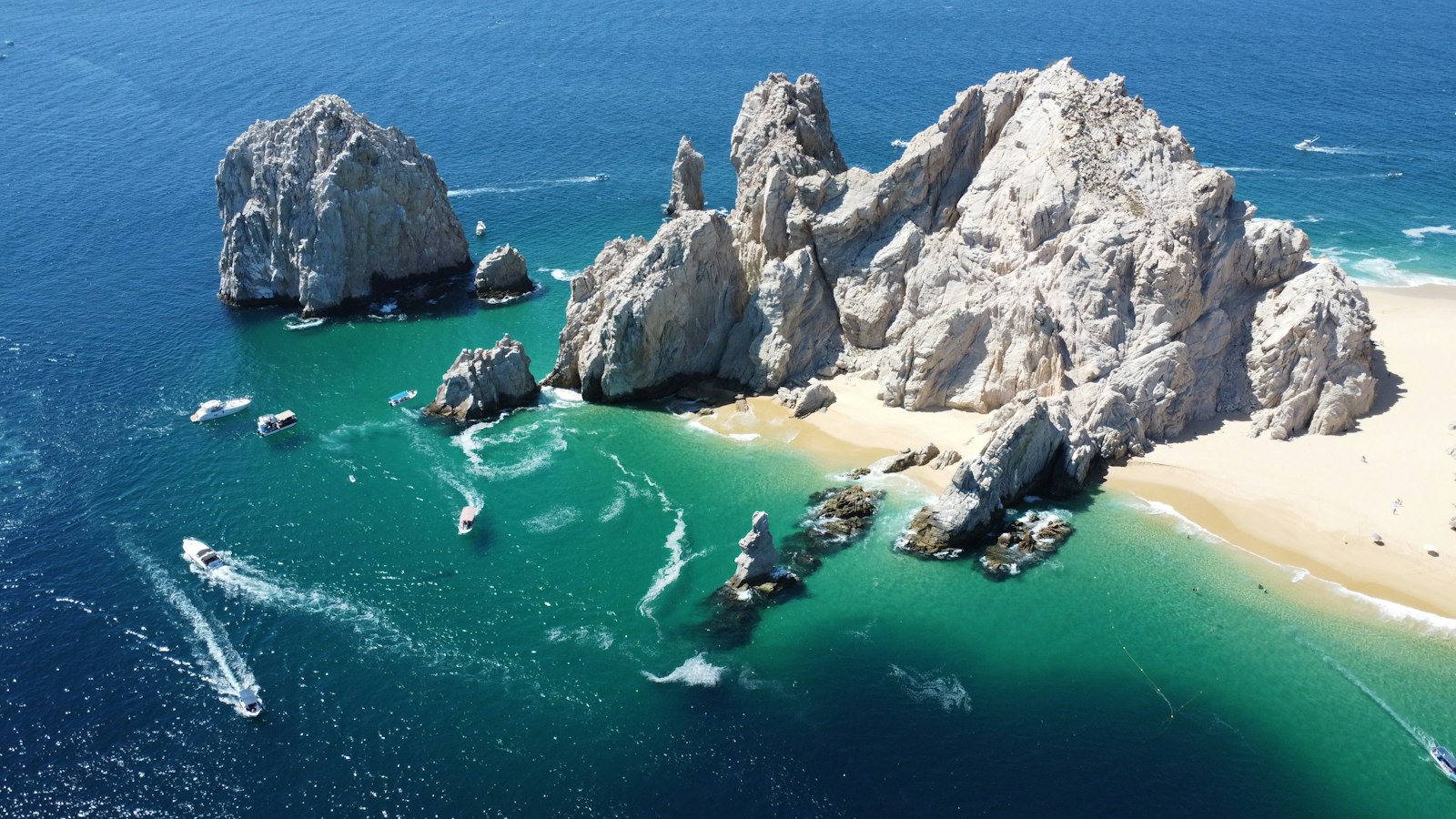
You come up the line to a different world. Water taxis, glass-bottom boats, a catamaran with the music going. The surface interval is 45 minutes to an hour on the boat with water and a snack, and most captains spend it on a slow pass of the Arch and the sea lion rocks. That's the same loop people pay a water taxi for, which I cover in my guide to El Arco and Lover's Beach, and you get it in a wetsuit with a granola bar.
The second dive is shallower. It's a sand slope and boulders with clouds of fish, and snorkelers' fins overhead. You're back at the dock around 11:30 and rinsed and paid by noon.
One thing to know if you go through air quickly. On a shared boat the group comes up together, and a dive can be over in about half an hour.
Which Sites to Ask For
Ask which two sites you're getting before you book. On a boat with beginners aboard, the default can be two dives on Pelican Rock, and you can do better than that.
- Neptune's Finger is the one I'd ask for first. It's a wall dive from about 30 feet down past 100, with the biggest of the sand falls and a spot where rays come in to be cleaned. It's for divers who are comfortable at 80 to 100 feet, and the depth creeps up on you.
- Land's End is the point itself, at about 30 to 80 feet, with the sea lion colony, schools of baitfish and snapper, and the remains of an old wreck. Surge and current pick up here, so it's an intermediate dive.
- The North Wall is the quiet beginner option. It's a rocky slope from about 20 to 90 feet with very little current, and morays and lobsters in the cracks.
- The Middle Wall is sheer and deep, from about 60 feet with no bottom under you. I wouldn't make it the first dive of a trip.
- Pelican Rock is the easy one, a sand slope and a boulder reef starting at about 15 feet. It's also the busiest spot in the bay, because every snorkel boat and every first-time diver uses it too.
If you're experienced and you hire a private guide, you can also ask about a blue-water drift off the point, away from the rock everyone else is on. That's where the bay's stories about hammerheads and big schools of rays come from. It needs a guide who's willing and a boat following you, and I wouldn't count on a shared boat doing it.
What's Actually Down There
Fish, and more of them than I expected the first time. This is the bay's real strength. At Pelican Rock the balloonfish follow you down the sand slope, because your fins stir up their lunch. They've figured out the tourists.
The sand falls are real. Sand from the shelf spills over a ledge and pours down the wall into the canyon. They're below the sand slope at Pelican Rock, which runs down to about 70 feet, and at Neptune's Finger. They only run when the surge is pushing, though, so some days the famous waterfall is a slope with a little sand trickling off it.
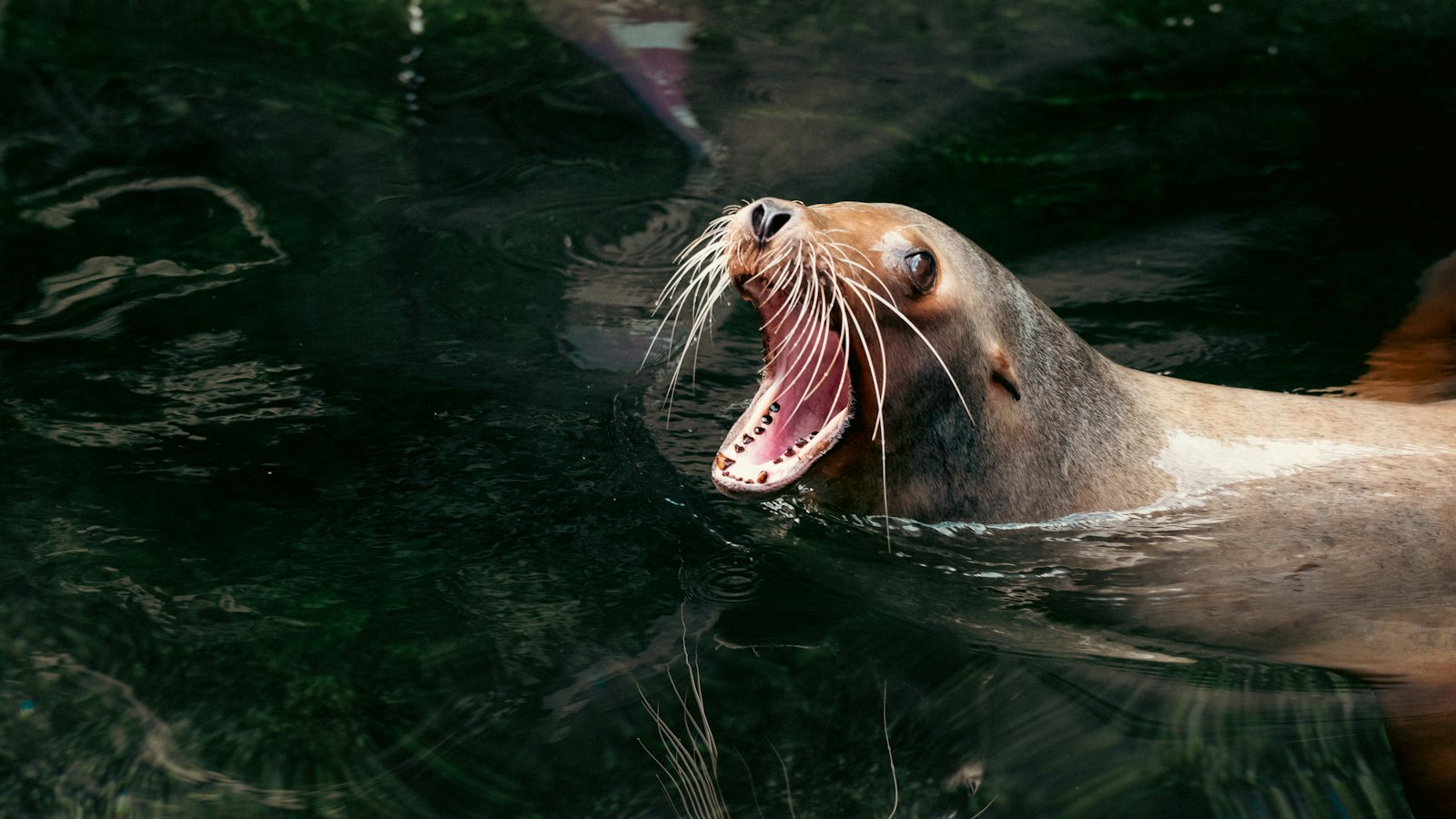
Sea lions in the water are a normal part of the Land's End dive. They're common and nobody can promise them. In my snorkeling in Cabo post I tell snorkelers that a real swim with a colony means Cabo Pulmo or La Paz, and that's still true from the surface. A diver at the point gets a much better shot at it.
What you won't get is coral. The bottom is granite and sand, same as it is for the snorkelers.
The Catch
The boats. Shops call this the Cabo San Lucas Marine Park, and it is a protected area with a fishing ban, but nobody limits how many boats can sit on a site. I've counted 20 to 30 over Pelican Rock and Land's End at once, in a patch of water about the size of a supermarket parking lot. All that traffic stirs up sand, so the water gets gritty, and you can hear engines over your head while you're down there.
So I carry a surface marker and use it, I come up on the guide's line or right beside the rock, and I never surface away from the group in open water. That's the one hazard that belongs to this site in particular.
The difference between a great morning here and a poor one is mostly the month and the hour. In late October and November, on the first boat, it's a lovely dive. On a January afternoon with ships in the bay, it's crowded and silty and I wouldn't blame you for shrugging.
The Corridor
If the boat traffic puts you off, this is the dive to book, and in winter I think it's the better call anyway.
It's the same check-in, then 30 to 40 minutes up the coast, two dives, and back around 1pm. The dives are mostly at 40 to 60 feet over ridges and finger reefs, with rays on the sand between them. It's quieter and calmer than the bay, and my one really good dive on a crowded winter trip was out here, with decent visibility and hardly another boat.
The sites you'll hear named are Chileno, Gavilanes, Whale's Head and the Blow Hole. Chileno is the deeper side of the same cove I send snorkelers to in my Chileno Bay guide. Gavilanes has some of the healthiest reef near town. Whale's Head is where spotted eagle rays come in to be cleaned. The Blow Hole is the deeper one, with big boulders down to about 100 feet. Shops mention white-tip reef sharks along here, and I'd treat one as a nice surprise.
What you give up is the wall, the sand falls and the sea lions. It also costs about US$20 more and an extra hour. And from May to October a swell from the south can make this coast rough enough that the boat turns back to the bay, so in summer I'd ask what the plan B is.
Bottom line: for a rusty diver, a newer diver, or anyone here in the cold months, I'd pick the Corridor over two dives at Pelican Rock.
Gordo Banks
Gordo Banks is a gamble, and I'd only take it if you're an advanced diver with days to spare and you'd be fine coming home having seen blue water.
It's a pair of seamounts in open ocean. The top is at about 100 to 115 feet and the dives go to 130. You go down a line through blue with no bottom to look at until the seamount shows up, spend twenty-some minutes at depth looking outward, and then hang in mid-water for a long safety stop. Then you bob in the swell for an hour and do it again. There's current, and the water at depth can be in the mid 60s even when the surface is warm.
The draw is hammerheads, plus silky sharks, mobulas, wahoo and tuna. On a good day you see a few hammerheads. The huge schools in the old photos are not what people come back describing now, and nobody will give you odds. Some days it's jacks.
Even the season is argued about. The shops that run the boats mostly say late August to January, with September to December the favorite stretch. One says the sharks turn up in May, and I've seen December to May printed too. I'd go with the people who drive the boat, in the fall, and keep my expectations low.
Here's what to know before you put a deposit down:
- It's a long way. Listings say seven or eight miles offshore, and that's measured from San José. From the Cabo San Lucas marina it's an hour and a half to two hours each way by boat. Some shops put you in a van to San José's marina instead, and then it's 40 to 60 minutes of boat.
- Every shop wants a check dive first. You do a regular local two-tank with them before they'll take you, so this is at least a two-day plan.
- Most shops want Advanced Open Water. One big shop's page says Open Water with conditions, and the conditions are strong buoyancy, good air consumption and recent deep dives. If you were certified last month, this isn't your dive yet.
- It gets canceled. Wind, swell, or too few divers signed up. I'd give it a three-day window and never my only free day.
- The price swings. About US$240 to $385 for two tanks, depending on the shop and how small the group is.
One shop asks every diver to carry a surface marker, a signaling horn and a marine rescue GPS. I think that tells you more about the dive than any of the photos do.
If you're staying in San José, you're closer to this than anyone in Cabo San Lucas, and there's a dive shop at the marina there.
Cabo Pulmo
Cabo Pulmo is the best diving within reach of Cabo, and as a day trip it's the hardest day of the four.
The diving is what the bay can't give you. It's real hard coral, schools of jacks thick enough to block the light, big calm snapper and grouper, small groups, and almost no boat traffic. The bull sharks are at a wrecked tuna boat in about 50 feet of water. They're most dependable in the cooler months, the park decides which boats get that site, and nobody can promise them.
From Cabo San Lucas, though, a dive day starts before 5:30am and gets you home around 5pm. That's five hours in a van, the last part on dirt, for two dives. The park limits how long each one runs, so you're underwater for about an hour and a half in total. It runs around US$325 with lunch and transportation, and gear is extra.
Stay a night in the village and the same two tanks are about US$160 to $200 with gear and the park fee, you're on the first boat without the alarm, and you've got a second morning if the wind takes the first. I think that's the only sensible way for a diver to do it. The drive, the dirt road and the cabañas are all in my Cabo Pulmo day trip post, and the rest of that coast is in my East Cape guide.
A few things that are different from the bay:
- The park runs the dive. It assigns your site on the day and sets the time limit, and your guide isn't allowed to take photos of you.
- Big camera rigs need a special permit. Ask your shop before you pack one.
- Shops want recent experience. One asks for a dive in the last year, and another asks for 20 logged dives.
- The surface interval is on a small open boat. If you get seasick, take something before you leave the beach.
- Winter is windy. From December to March the north wind cancels boats, and the visibility can be as poor as the bay's.
October and November are the months, with the clearest water of the year out there.
When to Go, and What Wetsuit That Means
The calendar matters more than which shop you pick. I've had the same site at Pelican Rock be murky and cold in one month and clear and warm in another, and the shop had nothing to do with it.
August to December is the warm, clear half of the year, and late October and November are the best of it. February to June is the cold, green half. That's the whole story in two sentences, and it's the opposite of what a lot of dive pages tell you about winter.
Visibility changes by the day, so read these as ranges I'd expect and never as a promise:
- Late October and November: 80 to 84°F on top, mid 70s at depth, and 40 to 80 feet of visibility. A 3 mm suit, or a 5 mm if you feel the cold or you're going deep.
- December: about 75°F, low 70s below, still good and slowly dropping off. A 5 mm. I think it's underrated.
- January: about 72°F, and 20 to 50 feet. A 5 mm, and some people add a hood.
- February to April: about 71°F at the surface and the low to mid 60s at depth, sometimes colder. Green water, 20 to 40 feet. A 5 mm or a 7 mm, and I've been cold in a 7.
- May to July: 74 to 78°F on top with sharp cold layers underneath, and the cloudiest water of the year. A 5 mm.
- August: about 83°F and clearing up, with the first south swells and storms. A 3 mm.
- September to mid-October: 84 to 85°F, and the least predictable. It can be 60 to 80 feet on a good day and 12 to 40 at Pelican Rock on another. A 3 mm for the bay.
On the very best days the bay gets to about 65 feet, maybe a little more. The number on the brochures is a lot higher than that, and I'd plan around mine.
Two things catch people out. The first is the cold layers. They're there all year, so a 3 mm that feels perfect at 30 feet in October is not enough at 90. The second is the wetsuit itself. On a dive shop's snorkel trip the wetsuit comes with the boat. On a scuba trip it's rental gear and you pay for it.
Winter does have one thing fall doesn't. From December to March you can hear humpbacks singing on your safety stop. You can't get in the water to look for whales, and seeing them is a separate boat trip that I cover in whale watching in Cabo. But hearing one through your hood on a cold green dive goes a long way.
September comes with a warning. When a storm passes offshore the port closes to small boats, sometimes for days, and no one dives. Don't leave your dive for the end of a September or October trip. There's more on that in my post on Cabo hurricane season, and the full year is in the best time to visit Cabo.
Whatever the month, take the morning boat. The water is flatter and there are fewer sightseeing boats. The afternoon boat gets the wind, the traffic and the first-timers.
What It Costs
A two-tank dive in the bay is about US$130 to $150, and the Corridor is about US$150. That includes tanks, weights, the guide, water and a snack. It doesn't include gear, a ride from your hotel or the tip.
Here's what lands on top:
- A full set of rental gear: about US$35 to $40. A dive computer is often extra.
- Renting by the piece: about US$10 each for a wetsuit, regulator or BCD.
- Dock fee: nothing at some shops, up to about US$5 in cash at others.
- Tip: I budget US$20 to $25 for the guide and the captain.
- Nitrox: free at one shop if you ask ahead, an extra charge per tank at another.
- Tax: most quotes include it. One or two don't, so ask.
So my estimate for one certified diver with rented gear is about US$185 to $215 for the morning, and about US$150 to $175 if you bring your own. That's my own arithmetic, and it'll drift.
A few other prices, all rough:
- A night dive: about US$140 for one tank, usually at Pelican Rock.
- A private guide on a shared boat: about US$100 extra.
- A private boat: from about US$600 for one or two divers.
- A non-diving partner riding along to snorkel: about US$45 at the shop I asked.
- Gordo Banks: US$240 to $385 for two tanks.
- Cabo Pulmo from Cabo San Lucas: about US$325, plus gear.
Bring cash. A couple of shops knock 5 to 10% off if you pay that way, and the dock fee and tips are cash anyway.
Is it worth it? The bay morning is, easily, in the warm months. At about US$200 it's fair money for two dives five minutes from town. In March I'd still do it once if I missed diving, knowing I was paying for cold water and 30 feet. Where it sits in a whole trip budget is in how much Cabo costs.
If You've Never Dived
You can try it here without being certified. I'd only do it in the warm months.
It's called Discover Scuba, and it runs about US$130 to $190 depending on the version. The two versions are pretty different, which is most of the price gap:
- Two boat dives, no pool. Dive Cabo runs it in the afternoon for about US$190 with all the gear included. You get a briefing, practice a few skills, and do two dives no deeper than 40 feet with an instructor beside you.
- A pool session first, then one ocean dive. Cabo Adventures does it this way. It's the gentler start, and the price moves around depending on where you buy it, so check the company's own site.
The minimum age is 10, and everyone fills out a medical form. A "yes" on that form means you need a doctor to sign off before you can go, so look at it before your trip and not at the dock. If you've got a kid who's dying to try, there's more on what works at each age in Cabo with kids.
Here's my honest take. A first dive here is harder than one in the Caribbean. It's a boat entry, the visibility is limited, there's traffic overhead, and for half the year the water is cold. The instructors are good at it. It's still a lot to ask of a nervous first-timer in March.
So from August to November, go for it. From January to June, I'd snorkel instead and save your first dive for warm water. The fish you'd see on a 40-foot beginner dive are the same fish you'll see with a mask at Chileno, for free. And the sand falls are deeper than a Discover dive goes, whatever the listing implies.
If you want to get certified here, the Open Water course takes two to three days and runs roughly US$400 to $700. Ask whether the online coursework is included in that number, because it often isn't. Just know that the ocean dives are cold from December to June.
How to Pick a Shop
Book directly with a dive shop on the marina. The activity desk at your hotel and the guy on the boardwalk are both selling you a seat on one of the same boats with a commission added.
The shops are closer to each other than their websites suggest. The crowding I described belongs to the sites, and every shop's boat is sitting in it. What does differ is this, and these are the questions I ask:
- How many divers per guide? Get a number. "Small groups" doesn't tell you anything.
- Which two sites, and can one of them be Neptune's Finger, the North Wall or the Corridor?
- What time is check-in? A 7:30 start gets to the site one wave of boats ahead of an 8:00 start.
- Are gear, nitrox, tax and the dock fee in the price? That's four separate questions.
- For Gordo Banks and Cabo Pulmo, whose boat and whose guide is it, and what happens to my money if it's canceled? Cabo Pulmo is always a local park-licensed boat, and Gordo is often a partner's boat from San José. Neither is a problem. You should just know.
Here's who I'd look at:
- Dive Cabo is the one I'd send most people to. It's right on the marina, it runs every trip in this post, nitrox is free if you ask ahead, and the photos come free. The bay two-tank is at the low end of the range. It doesn't publish how many divers go with each guide, so ask.
- Cabo Private Guide gives your own party its own guide and checks in at 7:30, which is exactly what I'd want on a busy day. It prices in pesos, and the more of you there are, the less each of you pays. It's also a Gordo Banks specialist, though it needs four divers to send a shared boat out there.
- Dive Ninja caps it at four divers per guide and charges more, a little more in the bay and a lot more at Gordo Banks. If small groups matter most to you, that's what the extra buys.
- See Creatures is a couple of blocks back from the marina and runs Gordo Banks with the strict kit list I mentioned. I like a shop that's that serious about an open-ocean dive.
If you're coming off a ship, a morning two-tank works. The shops are a few minutes' walk from where the tenders drop you, the sites are minutes away, and the whole thing is about four hours dock to dock. Book it directly and tell the shop your all-aboard time. How it fits with the tender is in my Cabo cruise port day post.
Flying, and the Chamber
Don't book a dive for the day you fly home. The standard guidance divers follow is to wait at least 12 hours before flying after a single no-decompression dive, and at least 18 hours after multiple dives or several days of diving, with longer after any decompression dive. A lot of shops and dive computers say 24.
In practice, a morning two-tank and a flight the next afternoon is fine. A two-tank and a flight that evening is not. If you're inside that window, snorkel.
There is a hyperbaric chamber in Cabo San Lucas, about ten minutes from the marina. That's close to the bay sites and a long way from the harder dives. Cabo Pulmo is more than two hours from it by road. That distance is the usual reason people buy dive insurance before a trip like this. And if anything feels wrong after a dive, tell your dive shop right away.
Socorro, La Paz, Mobulas and Whale Sharks
These come up every time, and none of them is part of a diving morning in Cabo.
Socorro. The liveaboards to the Socorro islands, which is some of the most serious big-animal diving anywhere, do board in Cabo San Lucas. Nautilus checks its guests in at a small dive shop near the town square in the evening and sails that night. The crossing takes about a day each way, the season runs from about November into early summer, and trips start around US$3,300. If that's your trip, a two-tank in the bay the day before is an easy warm-up.
La Paz. It has a sea lion rookery, wrecks and seamounts, and it's two and a half hours each way. The sea lion site is closed to getting in the water from June through August. I'd treat it as its own destination with a night or two, and I go through the day-trip version in my La Paz day trip post.
Mobula rays. The mobula trips sold in Cabo are snorkel and freedive trips, mostly a long drive north in late spring. On scuba you see mobulas when one happens to swim past.
Whale sharks. Those are in La Paz, never in Cabo, and you snorkel with them.
The Verdict
Diving in Cabo is worth one morning, and I'd do that morning every time I'm here in the fall.
What I love is that it's so easy. Five minutes from the dock there's a wall, a sea lion colony and more fish than you can keep track of, and you haven't given up a day of your vacation to see them. What I wish were different is everything above the water line. There are too many boats over two small sites, the visibility is modest even at its best, and the months with the nicest weather have the coldest, greenest water.
Here's where I'd send you:
- Certified, here from August to December: one two-tank in the bay on the first boat. Ask for Neptune's Finger.
- Certified, here from February to June: once, if you miss diving, in a 5 or 7 mm, expecting 20 to 40 feet. I'd pick the Corridor.
- Rusty: the bay or the Corridor, and tell the shop. Skip Gordo Banks and Cabo Pulmo's deeper sites this trip.
- Never dived: Discover Scuba from August to November. In winter and spring, a mask at Chileno.
- Keen diver with a week: one morning locally, then a night at Cabo Pulmo. If that's the heart of your trip, it's worth choosing a base closer to it, and I compare the areas in where to stay in Cabo.
- Advanced and after sharks: Gordo Banks in the fall, with a check dive, spare days and low expectations. Or Cabo Pulmo for the bull sharks.
- Diving with a non-diver: a bay two-tank at a shop that takes snorkelers along.
- Flying within 18 hours: snorkel.
Would I plan a whole dive vacation here? No. I'd plan a Cabo vacation with one really good morning of diving in it... and if I wanted more, I'd drive to Cabo Pulmo and sleep there.
And if I were texting it to a friend: yes, bring your card and your computer, rent the rest. One two-tank in the bay, first boat, book it with a marina shop directly. Ask which sites and how many divers per guide. Fall if you can, a thick suit if you can't. Bring cash. Don't dive the day before a morning flight. Cabo Pulmo only if you stay the night.
Quick Answers
Is scuba diving in Cabo good? It's good for fish numbers, sea lions and convenience, and only fair for visibility and coral. I'd give it one morning and I wouldn't build a dive trip around it.
How much does a dive cost in Cabo? About US$130 to $150 for two tanks in the bay, and about US$150 on the Corridor. With rented gear and a tip, I'd budget roughly US$185 to $215.
When is the best time to dive in Cabo? August to December, with late October and November the best. February to June is cold and green, with visibility around 20 to 40 feet.
What wetsuit do I need? A 3 mm from August to November, and a 5 mm or even a 7 mm from December to July. It's a lot colder at depth than at the surface in every month.
How long do I have to wait to fly after diving? The standard guidance is at least 12 hours after a single no-decompression dive and at least 18 hours after multiple dives or several days of diving. Many shops and dive computers say 24.